Why Your Google Rankings Stopped Driving Traffic
Your site ranks first. Traffic dropped 30% anyway. Why Google Rankings No Longer Guarantee TrafficHow To Leverage The AI Visibility System For Traffic has become the defining challenge for 2026.
Why Google Rankings No Longer Guarantee Traffic: The Zero-Click Reality
In March 2025, 27.2% of U.S. Google searches ended without a click, up from 24.4% in March 2024. This number tells only part of the story. 60% of Google searches now end without any click to a website.
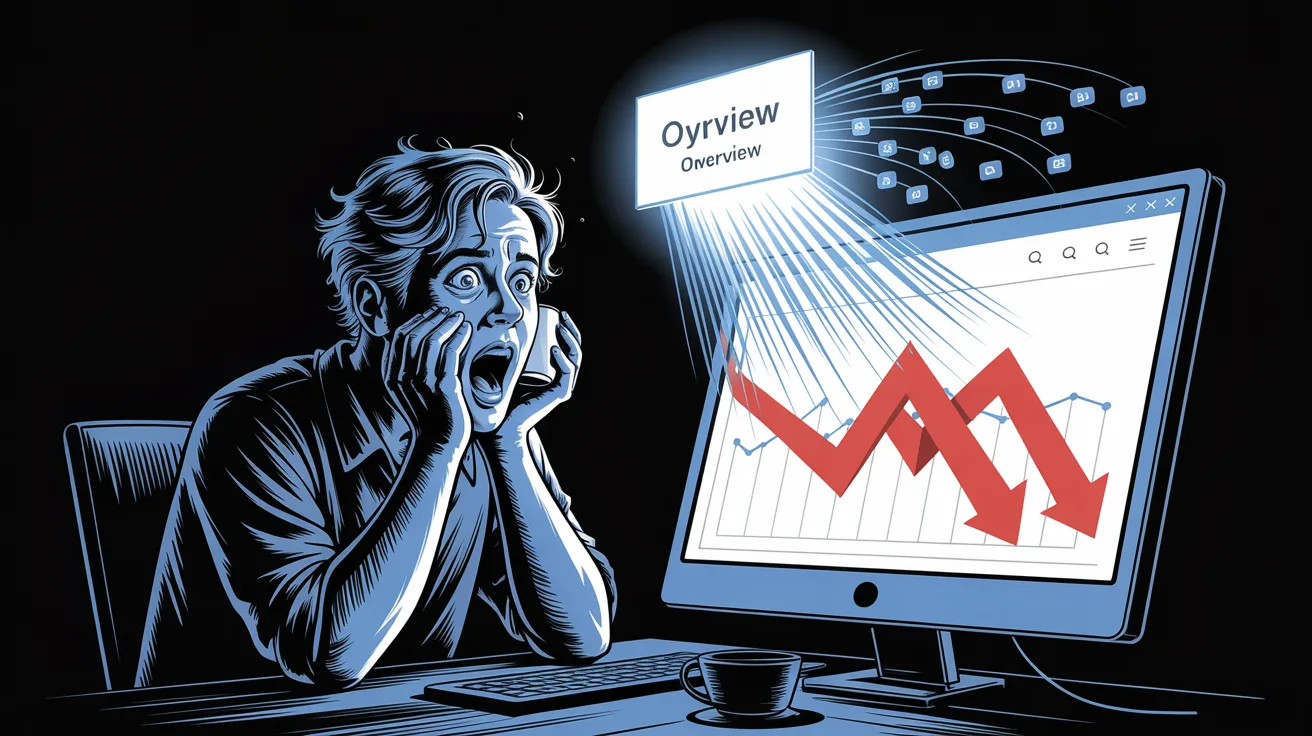
AI Overviews reduce the organic click-through rate for position one content by 58%. You rank first but lose more than half your clicks.
The mechanism is simple. AI-powered search engines like Google’s SGE and Bing Copilot deliver answers directly in the SERPs. Users get what they need without leaving Google’s page.
AI Overviews peaked at appearing for nearly 25% in July before sliding to 15.69% in November 2025. The rollout fluctuates. AI Overviews are slowly but surely starting to target lower-funnel searches. Commercial queries now trigger AI answers too.
When AI Overviews are present, click-through rates plummet to just 8%. Compare that to 15% for traditional search results without AI summaries. The math is brutal.
How Publishers Lost 30% of Their TrafficHow To Leverage The AI Visibility System Becomes Urgent
Traffic to CNN’s website has dropped about 30% from a year ago, and Business Insider’s and HuffPost’s sites saw traffic plunges around 40% in the same period.
Some publishers have reported significant traffic losses, with some seeing click-through rates drop by as much as 89%. DMG Media reported the steepest declines. The Daily Mail’s desktop CTR dropped from 25.23% to 2.79% when an AI Overview surfaced above a visible link.
News sites got hit hardest. For news queries specifically, zero-click outcomes rose from 56% to approximately 69% between May 2024 and May 2025.
Even educational platforms suffered. Learning platform Chegg reported a 49% decline in non-subscriber traffic between January 2024 and January 2025.
Traffic to the world’s 500 most visited publishers has dropped 27% year on year since February last year. That’s 64 million visits per month gone. AI chatbots have only delivered an increase of 5.5 million referrals per month in the same time frame.
The replacement traffic doesn’t come close to the loss.
Why Google Rankings No Longer Guarantee TrafficHow Featured Snippets Changed Everything
Featured snippets in first position earn a 42.9% click-through rate, higher than the standard rank-one organic result at 39.8%. Position zero beats position one.
Google’s AI Overviews reduce the organic click-through rate for position-one content by 58%. That makes the featured snippet box the most defensible territory on the results page, as your content is visible before AI Overviews push organic links below the fold.
The content that wins featured snippets is frequently the same content cited inside AI Overviews.
The structure matters more than rank. 99% of all Featured Snippets are from pages that already ranked on page 1. You need the baseline rank. Then you need snippet formatting.
The ideal length is 40 to 60 words, as Semrush data confirms this is the range Google extracts most consistently. Shorter answers lack context. Longer answers confuse the extraction.
Worth knowing.
The AI Search Engines Changing TrafficHow To Leverage The AI Visibility System For Citations
Google still accounts for roughly 80% of global query volume across all device types. The disruption is concentrated on informational and research queries, where ChatGPT Search, Perplexity, and Google AI Mode now absorb a meaningful slice of volume.
Every AI chatbot put together sent 0.27% of referral traffic. That’s ChatGPT, Gemini, Claude, and Perplexity combined. The volume sounds small.
AI search referrals reached 0.9% of total visits in March 2026, up 5x year-over-year. The trajectory is what matters.
Across 680 million AI citations analyzed, only 11% of domains were cited by both ChatGPT and Perplexity. The platforms source differently. The 11% overlap means treating AI visibility as a single number is like measuring your Google ranking and assuming it applies to Bing.
ChatGPT is the platform B2B teams care most about, and it is the one where brand visibility is consistently lowest. ChatGPT constructs answers more from parametric knowledge baked into training data than from real-time web citations, and the optimization playbook that works for citation-heavy platforms like Perplexity or Google AI Mode produces little result.
Different engines need different approaches.
How To Leverage The AI Visibility System For TrafficBeyond Traditional Rankings
Add specific statistics with methodology notes and sources, as this improves visibility by 22-28% across platforms, and restructure existing high-performing content with 120-180 word sections between hierarchical headers for 40% citation improvement.
Update your highest-value pages with visible “last updated” timestamps and fresh data for 30% more Perplexity citations and improved ChatGPT positioning.
If your product appears consistently across Reddit discussions, YouTube tutorials, industry publications, review sites like G2, and your own website, AI systems gain confidence in recommending you, as this is the “consensus signal” that triggers citations.
Brand web mentions correlate at 0.664 with AI citation rates, roughly three times stronger than backlinks at 0.218, and the brands appearing in ChatGPT answers are mentioned frequently across authoritative sources regardless of whether those mentions include a hyperlink.
Most people skip this.
A Yext analysis of 6.8 million AI citations shows that most citations come from brand-controlled sources, not forums. You control more than you think.
Why Google Rankings No Longer Guarantee TrafficThe Measurement Problem
Citation Rate measures the percentage of relevant AI responses that cite your content, alongside Sentiment Analysis for how AI characterizes your brand, Competitive Share for your mentions versus competitor mentions, and Conversion Attribution for revenue from AI-referred traffic.
Traditional analytics miss AI exposure. Add three tools to your measurement stack alongside Google Search Console: Otterly.ai, Promptmonitor, or Peec AI for direct AI citation monitoring.
AI Search traffic converts at 14.2% compared to Google’s 2.8%. The volume is smaller. The value is higher.
A 30% decline in sessions means something different if conversion rate from remaining traffic increased 5x, and if 500 AI-referred visitors generate more pipeline than 5,000 traditional organic visitors, the traffic decline is a measurement artifact, not a business problem.
Reframe the metrics.
How To Leverage The AI Visibility System For Traffic Structure and Schema
Rewrite paragraphs that start with “It,” “This,” or “They” to include explicit context, and convert dense paragraphs into tables, numbered lists, or FAQ schema where appropriate.
AI systems can’t infer. They extract. Refresh stale content by updating anything older than 30 days with new statistics or examples, then update the dateModified timestamp.
Snippet-ready content has always been structured, direct, and intent-aligned, and those are exactly the properties that AI systems favor when generating summaries and selecting citations, as content optimized for P0 now functions as a feed for multiple answer layers.
One optimization unlocks three surfaces.
Commercial domains dominate with over 80% of citations, while non-profit sites are the second most cited at 11.29%. TLD choice signals trust.
The Commercial Query ShiftHow To Leverage The AI Visibility System Protects Revenue
AI Overviews are slowly but surely starting to target lower-funnel searches, and by October, the share of commercial and transactional AIOs rose from 91.3% informational in January to 57.1%.
Transactional and branded query traffic has held up far better than informational queries, and the more directly a query can be answered on the SERP or inside an AI product, the larger the traffic loss for content sites, while transactional queries where the user must ultimately reach a merchant remain relatively insulated.
This is wrong. Informational content drives awareness. Losing top-funnel visibility means prospects never enter your ecosystem.
HubSpot now reports that just 10% of leads come from blog traffic, and they’ve pivoted to optimize for AI search citations, claiming to be “cited in LLMs more than any other CRM.”
The playbook exists. Companies are executing it.
Why Google Rankings No Longer Guarantee TrafficHow To Audit Your Current Position
Search for your category in ChatGPT, Perplexity, and Google AI, then note whether you’re mentioned, how you’re characterized, and who else appears.
Identify where you have strong presence and where you’re invisible, then prioritize the platforms where competitors appear but you don’t.
Run an AI visibility audit using a free AI visibility checker to measure your starting point across ChatGPT, Claude, and Perplexity.
Ask ChatGPT and Claude questions in your domain weekly, then check if you’re being cited or if competitors are. Manual testing still works.
The gap reveals the opportunity.
Run your first AI visibility audit this week across three platforms.
Frequently Asked Questions
What percentage of Google searches end without a click in 2026?
Approximately 60% of Google searches end without any click to a website. This figure varies by query type, with AI Overview-triggered searches reaching up to 83% zero-click rates. Mobile searches see even higher zero-click rates at 77% compared to 46.5% on desktop.
How much traffic do AI Overviews reduce for top-ranking pages?
AI Overviews reduce organic click-through rates for position one content by 58% as of December 2025. Some publishers report even steeper declines, with certain queries experiencing 80-90% lower CTR when AI summaries appear above organic results.
Do ChatGPT and Perplexity cite the same websites?
No. Only 11% of domains are cited by both ChatGPT and Perplexity. ChatGPT relies more on parametric knowledge from training data, while Perplexity uses real-time web citations. Optimizing for one platform does not guarantee visibility on the other.
Should I still optimize for featured snippets in 2026?
Yes. Featured snippets in position zero earn a 42.9% click-through rate, higher than standard first-position results at 39.8%. The same structured content that wins featured snippets is frequently cited inside AI Overviews, making it a dual-purpose optimization.
How do I measure AI visibility if traditional analytics don’t track it?
Use specialized tools like Otterly.ai, Promptmonitor, or Peec AI to track AI citations directly. Monitor your Citation Rate, Competitive Share, and Conversion Attribution from AI-referred traffic. Run manual queries weekly in ChatGPT, Perplexity, and Google AI to track brand mentions.