d” Google just answered your customer’s question before they clicked your link. How AI Overviews Are Changing SEO Forever And Why Google Rankings No Longer Guarantee TrafficHow To Leverage The AI Visibility System For Traffic is reshaping search behavior in 2026. Your position one ranking still shows strong impressions. But traffic keeps dropping because AI answers the query first.
How AI Overviews Are Changing SEO Forever And Why Rankings Mean Less
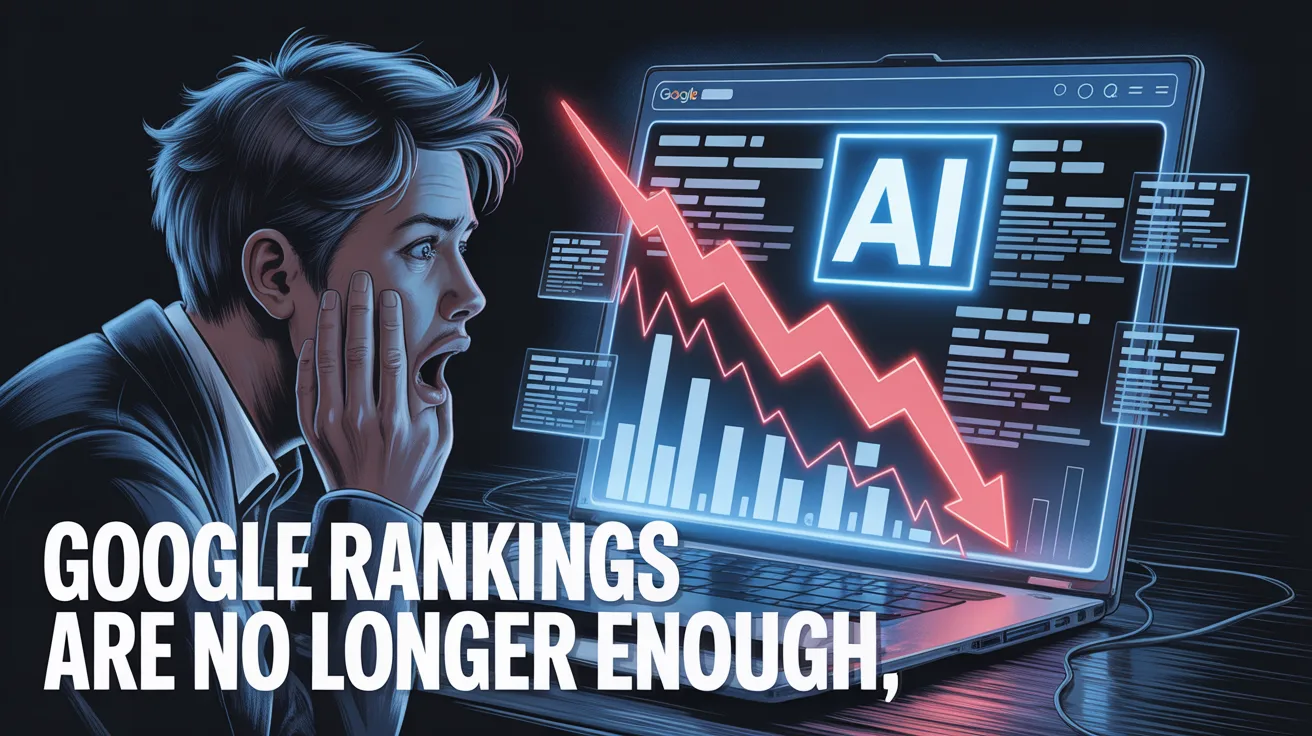
Some publishers have reported click-through rates dropping by as much as 89%. Position-1 rankings face the sharpest CTR declines at 34.5%. Rankings remain stable while traffic falls off a cliff. The disconnect reveals a fundamental shift in search behavior.
Zero-click searches increased from 56% to 69% between May 2024 and May 2025. Users get answers without leaving Google. AI summaries appear above your content. Your organic listing gets pushed below the fold.
AI Overviews and Featured Snippets together take up 75.7% of screen space on mobile and 67.1% on desktops. Even when you rank first, visibility collapses. Mobile users scroll past AI content before seeing traditional results.
Your Google rankings are stable but organic traffic is down 20 to 40%. Search Console shows growing impressions. Clicks decline month after month. This pattern defines the new search reality.
Traditional traffic goals no longer match actual performance. You need new metrics for visibility.
Why Google Rankings No Longer Guarantee TrafficHow Citations Replace Clicks
Seer Interactive’s September 2025 study reveals organic CTR plummeted 61% for queries with AI Overviews. The drop happened within months. Fast-moving categories saw steeper declines.
For keywords that triggered AI Overviews, the position one click-through rate plummeted from 7.3% to just 1.6%. Your top spot no longer delivers the same traffic. Citations inside AI summaries matter more than rank.
Brands cited in AI Overviews earn 35% more organic clicks and 91% more paid clicks. Being mentioned inside the AI answer drives better outcomes than ranking below it. Citation placement becomes the new conversion point.
Becoming a cited source in the AI answer is now just as important as ranking in the Top 10. Most users read the AI summary and stop there. When an AI Overview is shown, only 8% of users click on a link. Citations reach the other 92%.
97% of AI Overviews cite at least one source from the top 20 organic results. High rankings correlate with citations. But ranking well doesn’t guarantee inclusion. 75% of links in AI Overviews come from positions 12 or higher. Content outside the top ten still earns citations.
AI doesn’t respect traditional rank order. It pulls from wherever the answer lives.
How AI Overviews Are Changing SEO Forever Through Zero-Click Dominance
Searches triggering AI Overviews now show an average zero-click rate of 83%. Eight out of ten users never leave the search page. 93% of searches in AI Mode end without a click. Full conversational search removes almost all external traffic.
Despite still ranking on page one and impressions remaining relatively steady, the CTR fell sharply from 5.1 percent to 0.6 percent over the past year. Visibility metrics look healthy. Traffic tells a different story. Publishers watch impressions climb while revenue drops.
Click-through rates for the top-ranked result in searches with AI Overviews have dropped by an average of 34.5%. First place no longer guarantees clicks. Even if your content ranks in the top 3, it can still be skipped entirely if Google’s AI has already answered the user’s question. Content becomes invisible below the AI summary.
In the year before AI Overviews and AI Mode, all sectors saw growth in their ranking pages, up by 14.1% on average. After Google AI search features, ranking pages declined by -11.1% on average. Growth reversed across every industry studied. The shift happened in less than twelve months.
Different sectors experienced different intensities. B2B Technology faces the highest AI Overview exposure at 70%. Only 4% of e-commerce searches trigger AI Overviews in 2026. Transactional queries remain protected. Informational content takes the biggest hit.
How To Leverage The AI Visibility System For Traffic Through Citation Strategy
Traditional SEO focused on ranking. AI visibility focuses on being cited. AI content optimization focuses on becoming the source AI systems cite when generating answers. Citation authority replaces backlinks, and visibility score matters more than rank. Metrics shift from position to presence.
GEO is the emerging discipline of structuring content so that AI systems can find, understand, and cite it accurately. You need clear answers in scannable formats. Pages that include original data tables earn 4.1x more AI citations. Specific statistics drive inclusion.
Schema.org markup makes entity attributes machine-readable. Deploy Organization, Person, Product, and Service schemas across your site. Add FAQ and QAPage schemas to content likely to answer common questions. Structured data helps AI extract accurate information.
Slug structure shows the highest correlation with AI citation frequency among all technical variables. Clean, specific slugs that match search intent perform significantly better than generic or keyword-stuffed URLs. URL clarity beats keyword density in AI systems.
AI citation optimization performs best with sections of 120 to 180 words between headings. Break content into digestible chunks. Recently updated content earns nearly 2 times more citations than outdated pages. Freshness matters more for AI than for traditional search.
Develop content clusters around your core topics. Earn mentions on third-party sites and industry publications. Citations come from topical authority. Single pages rarely win inclusion.
How AI Overviews Are Changing SEO Forever And The Metrics That Matter Now
Traditional metrics like clicks and traffic are no longer enough, success now requires tracking share of voice, visibility in AI responses, and citation frequency. Your dashboard needs new KPIs. Impressions don’t translate to sessions anymore.
Most brands are flying blind when it comes to AI visibility, making optimization decisions without understanding their current position. Without baseline metrics, you have no way to determine whether your efforts are working. You can’t improve what you don’t measure. “you shoulTrack which prompts mention your brand.
Track the ratio of AI citations to organic clicks. Track assisted conversions from AI exposure alongside direct organic conversions. Revenue still matters most. Some citations convert better than clicks.
When people click from search results pages with AI Overviews, these clicks are higher quality, meaning users are more likely to spend more time on the site. Volume drops but intent rises. Users who click after reading the summary want deeper information.
The trend, however, has been businesses reporting declined traffic, but increased revenue. Public companies like NerdWallet and HubSpot have both shared how organic search traffic has declined, yet their revenues have increased. Traffic isn’t revenue. Quality beats quantity in AI-driven search.
In the agentic era of 2026, visibility is a competition for inclusion. Rankings show position. Citations show trust. AI systems recommend brands they can verify.
How To Leverage The AI Visibility System For Traffic Beyond Google Alone
Platforms like ChatGPT and Perplexity are surging in popularity. ChatGPT saw a 44% traffic boost in November 2024, and Perplexity reached 15 million monthly users in late 2024. Search happens across multiple platforms now. Google isn’t the only answer engine.
Traffic coming from ChatGPT is less than 5% of what they get from Google Organic. Alternative platforms remain small today. But growth rates show trajectory. By the end of 2026, 25% of organic search traffic will shift to AI chatbots and voice assistants. The channel mix keeps evolving.
CJ has built this methodology into its AI Visibility and Optimization solution. The approach combines proprietary deterministic AI visibility measurement technology with insights and data from several leading third-party optimization solutions. Specialized tools track citations across platforms. Manual monitoring doesn’t scale.
Don’t focus exclusively on Google AI Overviews while ignoring ChatGPT, Perplexity, and other platforms. Build a comprehensive cross-platform strategy. Citations in ChatGPT follow different patterns than Google. Each platform pulls from different sources.
Optimize for AI crawlability. Adapt your content for semantic search, emphasizing high-intent, long-tail terms. Forget PDFs and gated content—they’re relics in an AI-driven ecosystem. AI systems need open access to cite you.
Stop thinking in terms of single-channel optimization. Build authority that works across all answer engines.
How AI Overviews Are Changing SEO Forever And What Content Wins Citations
Provide unique insights, opinions, and real-world data AI might not summarize. Generic content gets ignored. AI can generate general guides, it often lacks the ability to walk users through complex processes with precision. Content that breaks down tasks into clear, actionable steps makes a significant difference in engagement and retention. Depth beats breadth.
Leading e-commerce brands now invest in product-specific buying guides featuring original testing results, expert-authored comparisons, and interactive recommendation tools that AI Overviews cite as authoritative sources but cannot replicate. This approach earns AI Overview citations that attract high-intent visitors with significantly higher purchase conversion rates. Original research creates competitive moats.
With AI Overviews now embedding video content directly in search results, businesses that leverage multimedia effectively can gain an edge over competitors relying solely on written content. To increase visibility in AI-powered search, brands must ensure their video content is both high-quality and optimized for discovery. Text-only strategies miss opportunities. Video appears in AI summaries now.
Research shows that adding specific statistics and structured answers drives the fastest gains in AI citations, with tactical changes improving visibility within 30 to 45 days. You don’t need to wait months for results. Structured improvements show impact quickly.
How AI Overviews Are Changing SEO Forever And Why Google Rankings No Longer Guarantee TrafficHow To Leverage The AI Visibility System For Traffic requires rethinking everything. Citations replace clicks. Visibility replaces rankings. Authority across platforms replaces single-channel dominance.
Audit which of your keywords now trigger AI Overviews in Search Console today.
Frequently Asked Questions
Can you still get traffic if AI Overviews answer the question?
Yes, but the traffic quality improves while volume drops. Users who click after reading an AI summary want deeper information and convert better. Your content needs depth that AI summaries cannot replicate. Focus on original data, detailed processes, and expert analysis that goes beyond surface answers.
How do you get cited in AI Overviews?
Structure content with clear headings between 120 and 180 words per section. Add schema markup for FAQs and answers. Include original statistics and data tables. Use clean URL slugs that match search intent. Update content regularly since freshness doubles citation rates compared to outdated pages.
Should you block AI crawlers to protect your content?
No, blocking AI crawlers makes you invisible in AI search entirely. Being cited provides brand exposure and authority even without direct clicks. AI Overviews pull from the same crawl as traditional search, so blocking them removes you from regular Google results too. Citations build trust that converts later.
Which industries are most affected by AI Overviews?
B2B technology faces 70% AI Overview exposure with the steepest impact. Health and education see high appearance rates too. E-commerce queries trigger AI Overviews only 4% of the time. Local searches remain protected because users need maps, hours, and contact details that AI cannot fully satisfy.
What metrics should replace traditional SEO rankings?
Track citation frequency across AI platforms, share of voice in AI responses, and assisted conversions from AI exposure. Monitor the ratio of AI citations to organic clicks. Measure visibility in ChatGPT, Perplexity, and Google AI Overviews separately. Focus on revenue per session rather than total traffic volume.